 the updated logo
Wednesday, October 22, 2008
Web Startup Group Meets Thursday Night
The first official Web Startup Group meeting is tomorrow night. It should be a fun event that good things will come from. It will be at 7:00 PM in the TMCB at Brigham Young University. All interested are welcome to attend.the updated logo
the updated logo

Wednesday, October 15, 2008
Security Analysis of Reputation Systems
I came across this report on reputation-based systems today which I found at a reputation based social capital blog. It highlights the security threats against current reputation systems, use cases, and even ten recommendations to combat these threats.
Snapshot of the some of the recommendationsFriday, October 10, 2008
Information Pathways in Social Networks
The first talk presented in the social network session of KDD 2008 was for an interesting paper by G. Kossinets, J. Kleinberg, and D. Watts titled The Structure of Information Pathways in a Social Communication Network (PDF). Although I was not at KDD I was able to watch it online at videolectures.net.
 Kleinberg, the presenter, made some interesting observations having to do with our "rhythmic" everyday conversations. The approach to analyzing communication within these social networks is focused on the frequency of correspondence, rather than the content conveyed.
They measure "distance" between individuals by measuring the minimum time required for information to pass from one node to another. A methodology based on Lamport's work and vector clocks in the area of distributed computing.
Using this metric they are able to filter a busy network (one having edges for all communication packets) in a simplified network that contains only the edges that are minimum-delay paths between a pair of nodes. They call this simplified network view the network backbone. Below is an example of such a network (along with the caption) taken from the paper.
 The nodes further outside of the center of the graph are more "out-of-date" with respect to node v, since they communicate less frequently.
I found the approach to be novel and useful. As with nearly any analysis technique, caution should be used in selecting the time-period and group size to be studied. Recency and frequency issues come into play as correspondence is aggregated. However, this pursuit offers another approach for more fully understanding information flow.
Kleinberg, the presenter, made some interesting observations having to do with our "rhythmic" everyday conversations. The approach to analyzing communication within these social networks is focused on the frequency of correspondence, rather than the content conveyed.They measure "distance" between individuals by measuring the minimum time required for information to pass from one node to another. A methodology based on Lamport's work and vector clocks in the area of distributed computing.
Using this metric they are able to filter a busy network (one having edges for all communication packets) in a simplified network that contains only the edges that are minimum-delay paths between a pair of nodes. They call this simplified network view the network backbone. Below is an example of such a network (along with the caption) taken from the paper.
The nodes further outside of the center of the graph are more "out-of-date" with respect to node v, since they communicate less frequently.I found the approach to be novel and useful. As with nearly any analysis technique, caution should be used in selecting the time-period and group size to be studied. Recency and frequency issues come into play as correspondence is aggregated. However, this pursuit offers another approach for more fully understanding information flow.
Monday, October 06, 2008
Revision Control
If you worked on software in collaboration with multiple developers, then you've probably used (or wished you used) some sort of revision control system. The Google Search Volume Index plot below suggests some trends surrounding the currently available tools.
(Note: by no means is this very scientific, due to the fact that people searching with these terms could have been searching for something entirely different.)
 CVS, although huge in its time, is on the decline, while SVN, Git, and Mercurial are on the rise. I have used plenty of CVS and SVN to be ready for change. I am now using Git which I have really liked so far. If you have already been using SVN as I had, I would recommend the Git-SVN Crash course to get started quickly.
(Note: by no means is this very scientific, due to the fact that people searching with these terms could have been searching for something entirely different.)
 CVS, although huge in its time, is on the decline, while SVN, Git, and Mercurial are on the rise. I have used plenty of CVS and SVN to be ready for change. I am now using Git which I have really liked so far. If you have already been using SVN as I had, I would recommend the Git-SVN Crash course to get started quickly.
Thursday, October 02, 2008
Facebook growth rising past MySpace
From my local perspective Facebook has been on the rise --- I've noticed that many of my less computer savvy friends have now joined Facebook. I wondered if this trend was global, so I decided to investigate...
During the past few years MySpace has been the dominant social network, however, Facebook has continued to grow much quicker and is expected to become the leading social network. The first plot below (Figure 1) shows a comparison of searches for the keywords "facebook" and "myspace". Lately, for most of 2008, Facebook has been getting a little more attention in the news (lower portion of Figure 1) and has achieved a significantly higher search volume index.
 Figure 1. Search Volume Index Comparison of 'facebook' and 'myspace'
(source: Google Trends)
Figure 2 shows the massive popularity of MySpace which began late in 2004, peaked in the middle of 2006, and has since declined --- possibly in part due to the rise of Facebook.
 Figure 2. Search Volume Index of 'facebook.com' and 'myspace.com'
(source: Google Trends)
Finally, Figure 3 shows the number of daily unique visitors to Facebook as being more than that of MySpace as far back as November of 2007. (I'm not sure, but I would guess these figures to be based upon Google search result click-thrus)
 Figure 3. Daily Unique Visitors of 'facebook' and 'myspace'
(source: Google Trends)
I find it very interesting to see how quickly social networks grow and evolve. As an aside, I think that Facebook is doing things more efficiently and currently providing a better service.
During the past few years MySpace has been the dominant social network, however, Facebook has continued to grow much quicker and is expected to become the leading social network. The first plot below (Figure 1) shows a comparison of searches for the keywords "facebook" and "myspace". Lately, for most of 2008, Facebook has been getting a little more attention in the news (lower portion of Figure 1) and has achieved a significantly higher search volume index.
 Figure 1. Search Volume Index Comparison of 'facebook' and 'myspace'
(source: Google Trends)
Figure 2 shows the massive popularity of MySpace which began late in 2004, peaked in the middle of 2006, and has since declined --- possibly in part due to the rise of Facebook.
 Figure 2. Search Volume Index of 'facebook.com' and 'myspace.com'
(source: Google Trends)
 Figure 3. Daily Unique Visitors of 'facebook' and 'myspace'
(source: Google Trends)
I find it very interesting to see how quickly social networks grow and evolve. As an aside, I think that Facebook is doing things more efficiently and currently providing a better service.
Wednesday, September 24, 2008
The Web Startup Group
 Today, we founded the Web Startup Group to bring together people interested in creating new sites and services online. Group members include web developers (programmers and designers), marketing and business-minded individuals, creative idea people, and others with technology related skills. The group intends to meet regularly to discuss and make these ideas come to life.
If you are here at BYU and are interested in making a difference online then come join us!
Monday, September 22, 2008
Social Capital, Nan Lin
This is a great book that provides a sociologist's perspective on social capital.
Sunday, September 14, 2008
Google Releases a Browser
 Google Chrome is the new Web browser that was just released for Windows. It is much faster, elegant, and easy to use than Firefox, IE, and Safari. After using it for a day, the I love everything about it except for the following:
- It is not available for Mac yet (currently only for Windows)
- Nifty plug-ins are not yet available (Firefox wins here)
Google's Picassa 3 (Beta)
Picassa 3 is now available which has some pretty nice updates. Watch the video above to hear about what has been added. I just wish they had a Mac version available as it is superior to iPhoto. (Note: The current release is still Beta, which means that there will likely be a few minor bugs here and there.)
Saturday, August 02, 2008
Eclipse for Web Development
Well, I've been doing quite a bit of programming lately, however, it has been in a number of different languages. Naturally, I have considered Eclipse as a possible editor. Vanilla Eclipse is usually geared to toward Java development and can become tricky and tedious to setup for Web Development (hence the rise of Aptana). Eclipse can be great to work with, but only when you can get it working how you'd like. The following update sites may be helpful to get Eclipse setup how you hope to have it:
JavaScript
http://download.macromedia.com/pub/labs/jseclipse/autoinstall (JSEclipse)
Python
http://pydev.sourceforge.net/updates/ (PyDev)
PHP
http://update.phpeclipse.net/update/nightly (PHPEclipse)
Java Tapestry
http://m2eclipse.sonatype.org/update (Maven2)
http://jettylauncher.sourceforge.net/updates (Jetty)
Currently, all of these plugins can be loaded into a single installation of Eclipse Europa. However, I'm not sure that they are all compatible with Ganymede (latest version of Eclipse).
JavaScript
http://download.macromedia.com/pub/labs/jseclipse/autoinstall (JSEclipse)
Python
http://pydev.sourceforge.net/updates/ (PyDev)
PHP
http://update.phpeclipse.net/update/nightly (PHPEclipse)
Java Tapestry
http://m2eclipse.sonatype.org/update (Maven2)
http://jettylauncher.sourceforge.net/updates (Jetty)
Currently, all of these plugins can be loaded into a single installation of Eclipse Europa. However, I'm not sure that they are all compatible with Ganymede (latest version of Eclipse).
Tuesday, July 08, 2008
Saturday, May 24, 2008
Nifty Data Technique
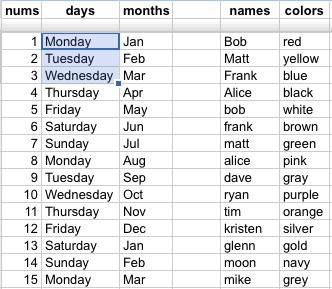
Google Spreadsheets now added some nifty ways to auto-fill data. For instance, rather than typing all of the days or months, you can simply type two or three, select them, and then drag the little blue square in the bottom right corner of the selection. Then, the rest of the days or months will be populated below. That is nice, but what I think is much more interesting, is that you can click and drag holding while down Ctrl (Windows and Linux) or Option (Mac) to pull data from Google Sets. So, in the image below, I only filled in the first three rows of each column. Then, I used the former technique to auto-fill the first three columns and the latter technique (holding down Ctrl or Option) to auto-fill the extra twelve rows.
Nowadays, software developers, such as Google, have a great opportunity to utilize the ginormous pile of data available online. The data that individuals generate is ever increasing and can be extraordinarily useful.
Nowadays, software developers, such as Google, have a great opportunity to utilize the ginormous pile of data available online. The data that individuals generate is ever increasing and can be extraordinarily useful.
Save R Plot in EPS format
Here is a code example of how to save an R plot in EPS (instead of PS):
postscript(file="testplot.eps",
           paper="special",
           width=10,
           height=10,
           horizontal=FALSE)

yvalues = runif(50)
plot(yvalues)

dev.off()
paper="special" and horizontal=FALSE.
Friday, May 16, 2008
Java Programming Notes
Java Programming Notes is a handy Java reference by Fred Swartz. In his words, he explains: 
These Java programming notes are written to fill in missing or weak topics in textbooks that I've taught from. Many pages are useful for reference, but not as an ordered tutorial. Some pages are still rough drafts, but I'm slowly working on fixing them.

Subscribe to:
Posts (Atom)