Social capital in action surrounds us. Below is a list of sites focused on the niche of starting up new businesses. In order for such ventures to be successful, it is often necessary to build a team of individuals that have complementary attributes and abilities. We are currently working on ways that we can quantify some of these behaviors given the rich data that is generated online everyday.
Friday, January 30, 2009


Wednesday, January 28, 2009
Social dimensions of social media
Below is the slide presentation that Marc Smith gave at ICWSM. I met Marc at the CIKM 2008 Workshop on Search in Social Media (SSM 2008) in Napa Valley, CA. He is a creative thinker that is always interesting to watch and listen to.
Also, you can watch the video of this presentation by clicking the picture below:

Social dimension of social media (Marc Smith)
Enjoy!

Also, you can watch the video of this presentation by clicking the picture below:
Social dimension of social media (Marc Smith)
Enjoy!
Thursday, January 15, 2009
Family Reunion on Facebook
Reunion sites are used primarily to "get the word out" about the reunion (e.g., location, events, cost), gather people's information (e.g., family member names), collect dues, and share family media (e.g., stories, pictures, videos).
Traditionally, I've been the guy that gets asked to build the reunion website --- as I'm involved in the planning meetings. Through the years, I've built a few high school reunion sites and a family reunion site. Through the process I have reused much of the code, yet they have all been "custom" websites. Although I had big plans to make my code generic enough that anyone could create a reunion site, I never took the time to do it. Since creating my last reunion site there have been a number of others that have taken the time to do this. For example, Ning and MyEvent are among a host of such sites that people have used to create reunion sites.
 Currently, I believe that the quickest and most efficient way to do a reunion website is on Facebook. Here are a few reasons why I currently believe it to be most efficient solution:
Traditionally, I've been the guy that gets asked to build the reunion website --- as I'm involved in the planning meetings. Through the years, I've built a few high school reunion sites and a family reunion site. Through the process I have reused much of the code, yet they have all been "custom" websites. Although I had big plans to make my code generic enough that anyone could create a reunion site, I never took the time to do it. Since creating my last reunion site there have been a number of others that have taken the time to do this. For example, Ning and MyEvent are among a host of such sites that people have used to create reunion sites.
 Currently, I believe that the quickest and most efficient way to do a reunion website is on Facebook. Here are a few reasons why I currently believe it to be most efficient solution:
- It is free
- No coding is necessary (saving time and money)
- Lots of your family is likely already using Facebook, so they will not have to register for another account or re-enter information
- People using Facebook already have media shared and can easily share more, which makes it easy to "catch-up" with family members
- It is easy to create a Group specifically for you family reunion allowing family members to join
- It is easy to create a "Related Event" for the group (i.e., the reunion activities) that members can easily indicate whether or not they plan to attend
- In general, it is much more interactive than any of the other reunion sites
- It may even be "one of the most fulfilling experiences of [your] life"
- The Network will continue on, even after your planned event is over
Saturday, December 27, 2008
Recording Skype Calls
Here are the basic settings that I used on a Mac to record Skype conversations using SoundFlower, Skype, and Audacity.
SoundFlower
Default Input: SoundFlower (2ch)
Default Output: Built-in Output
Skype
Audio output: SoundFlower (2ch)
Audio input: SoundFlower (2ch) (if you wan't to record both sides of the Skype call)
Built-in Microphone (if you only wish to record the other side of the conversation)
Audacity
Recording Device: SoundFlower (2ch)
Playback Device: Core Audio: Built-in Output
You could record many other things using similar configurations. Happy Recording!
Update: Since writing this I happened to come across another tutorial on doing this with pictures, that you might wish to follow.
SoundFlower
Default Input: SoundFlower (2ch)
Default Output: Built-in Output
Skype
Audio output: SoundFlower (2ch)
Audio input: SoundFlower (2ch) (if you wan't to record both sides of the Skype call)
Built-in Microphone (if you only wish to record the other side of the conversation)
Audacity
Recording Device: SoundFlower (2ch)
Playback Device: Core Audio: Built-in Output
You could record many other things using similar configurations. Happy Recording!
Update: Since writing this I happened to come across another tutorial on doing this with pictures, that you might wish to follow.
Tuesday, December 16, 2008
Network Roles
Social networks tend to have people that fill positions within the community. For example, within an academic community the roles of being a professor or a student can sometimes be identified solely by using the directed interactions among the individuals. To perform such an analysis, some measure of equivalence is used. In Social Network Analysis by Wasserman and Fauts, the following definitions of equivalence are reviewed (each with a note):
- Structural Equivalence - requires identical ties to other identical actors
- Automorphic and Isomorphic Equivalence - requires identical ties to other actors
- Regular Equivalence - actors have identical ties to and from equivalent actors
- Local Role Equivalence - actors are role equivalent if they have the same role sets
- Ego Algebra Equivalence - based on algebra of relational structures
 So, why is knowing how to use this important? Well, say you would like to better understand the network surrounding your blog by learning which other blogs are similar in their ties as you, then this is how you could do it.

Friday, November 28, 2008
Blog Posts Increasing and Cyclic

During the span of a year, the over 200 blogs aggregated above show very cyclic behavior. It shows very prominently that these bloggers post significantly more posts during the week rather than on the weekends.
Additionally, as time went on, these blogs as a group posted more frequently.
I would guess that the sink during December was caused by the Christmas holiday.
Tuesday, November 25, 2008
Christmas Gift Giving Tool
Christmas is a time for gift-giving --- sometimes, families and friends need a quick way to determine who gives to who. So, I created this little tool that allows families and friends to quickly enter the names of people (that will be giving and receiving gifts) to have gift-giving list automatically (and randomly) generated.

It is nice to have a tool like this so the lists can be generated early and gift-giving becomes that much easier --- you don't have to wait until somebody gets the old hat out and writes down everyone's name. Additionally, it seems to be more fair and is less complicated. ;)
The program was built using Python and Google App Engine.
It is nice to have a tool like this so the lists can be generated early and gift-giving becomes that much easier --- you don't have to wait until somebody gets the old hat out and writes down everyone's name. Additionally, it seems to be more fair and is less complicated. ;)
The program was built using Python and Google App Engine.
Thursday, November 20, 2008
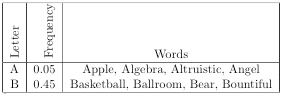
LaTex: Vertical Text
Scientific publications in computer science are often created using LaTeX. Here is a little tip for making text appear vertically in Latex.
First, you need to include the following library:
Next, you can use the
Finally here is an example used within a table:
Which produces:
First, you need to include the following library:
\usepackage{rotating}Next, you can use the
sideways environment, as follows:\begin{sideways}YOURTEXT\end{sideways}Finally here is an example used within a table:
\begin{tabular}{|r|r|c|}\hline
\begin{sideways}Letter\end{sideways} & \begin{sideways}Frequency\end{sideways} & Words \\
\hline
A & 0.05 & Apple, Algebra, Altruistic, Angel \\
B & 0.45 & Basketball, Ballroom, Bear, Bountiful \\
\hline
\end{tabular}
Which produces:
Tuesday, November 04, 2008
Obama: 44th US President
 Barack Obama has been elected as the next President of the United States of America. I enjoyed following the election coverage this season as it was particularly exciting. Although my first choice for President was Mitt Romney, I believe that Obama will work to unite the country and improve International relations.
Thursday, October 30, 2008
PIKM - rough notes
Session 1: Chair - Prasan Roy
A SQL Database System for Solving Constraints
An interesting take on enhancing SQL to solve constraint problems
Acquiring Advanced Properties in Ontology Mapping
Using ontologies to improve knowledge management
Social Capital in Online Communities
This was my presentation. ;)
Session 2: Chair - Aparna Varde
Concept Search in Urdu - interesting challenges. He proposes to write a language specific stemmer to be used for the Urdu language
Topic Models and a Revisit of Text-related Applications
An Extended Cooperative Transaction Model for XML
Session 3: Chair - Anisoara Nica
The Benefit of additional Semantics in Folksonomy Systems
Exploiting additional context in folksonomies (abel@L3S.de)
Ideas: GroupMe, Social HITS, Automating MOAT, relations between tag assignments
MOAT - Meaning of a Tag (automatic MOAT using context of resource), MOAT server, DBPedia
A Microscopic View on Community Detection in Complex Networks - No Show
Towards Privacy-Preserving Integration of Distributed Heterogeneous Data
Privacy-Perserving Data Sharing Architecture. Pawel Jurczyk presented a fairly complex system which hopes to solve the problem of preserving privacy when sharing data. This approach could be applied to hospitals that wish to share data in order to make use of one another's data.
Concurrency Control and Recovery for Multiversion Database Structures
Tuukka Haapasalo (thaapasa@cs.hut.fi) proposes a solution for multiversion databases. Propositions: 1) extend B-Trees: TSBT, Transactional MVBT, or 2) Two-dimensional R-tree.
A SQL Database System for Solving Constraints
An interesting take on enhancing SQL to solve constraint problems
Acquiring Advanced Properties in Ontology Mapping
Using ontologies to improve knowledge management
Social Capital in Online Communities
This was my presentation. ;)
Session 2: Chair - Aparna Varde
Concept Search in Urdu - interesting challenges. He proposes to write a language specific stemmer to be used for the Urdu language
Topic Models and a Revisit of Text-related Applications
An Extended Cooperative Transaction Model for XML
Session 3: Chair - Anisoara Nica
The Benefit of additional Semantics in Folksonomy Systems
Exploiting additional context in folksonomies (abel@L3S.de)
Ideas: GroupMe, Social HITS, Automating MOAT, relations between tag assignments
MOAT - Meaning of a Tag (automatic MOAT using context of resource), MOAT server, DBPedia
A Microscopic View on Community Detection in Complex Networks - No Show
Towards Privacy-Preserving Integration of Distributed Heterogeneous Data
Privacy-Perserving Data Sharing Architecture. Pawel Jurczyk presented a fairly complex system which hopes to solve the problem of preserving privacy when sharing data. This approach could be applied to hospitals that wish to share data in order to make use of one another's data.
Concurrency Control and Recovery for Multiversion Database Structures
Tuukka Haapasalo (thaapasa@cs.hut.fi) proposes a solution for multiversion databases. Propositions: 1) extend B-Trees: TSBT, Transactional MVBT, or 2) Two-dimensional R-tree.
Wednesday, October 22, 2008
Web Startup Group Meets Thursday Night
The first official Web Startup Group meeting is tomorrow night. It should be a fun event that good things will come from. It will be at 7:00 PM in the TMCB at Brigham Young University. All interested are welcome to attend. the updated logo
the updated logoWednesday, October 15, 2008
Security Analysis of Reputation Systems
I came across this report on reputation-based systems today which I found at a reputation based social capital blog. It highlights the security threats against current reputation systems, use cases, and even ten recommendations to combat these threats.
Snapshot of the some of the recommendationsFriday, October 10, 2008
Information Pathways in Social Networks
The first talk presented in the social network session of KDD 2008 was for an interesting paper by G. Kossinets, J. Kleinberg, and D. Watts titled The Structure of Information Pathways in a Social Communication Network (PDF). Although I was not at KDD I was able to watch it online at videolectures.net.
 Kleinberg, the presenter, made some interesting observations having to do with our "rhythmic" everyday conversations. The approach to analyzing communication within these social networks is focused on the frequency of correspondence, rather than the content conveyed.
They measure "distance" between individuals by measuring the minimum time required for information to pass from one node to another. A methodology based on Lamport's work and vector clocks in the area of distributed computing.
Using this metric they are able to filter a busy network (one having edges for all communication packets) in a simplified network that contains only the edges that are minimum-delay paths between a pair of nodes. They call this simplified network view the network backbone. Below is an example of such a network (along with the caption) taken from the paper.
 The nodes further outside of the center of the graph are more "out-of-date" with respect to node v, since they communicate less frequently.
I found the approach to be novel and useful. As with nearly any analysis technique, caution should be used in selecting the time-period and group size to be studied. Recency and frequency issues come into play as correspondence is aggregated. However, this pursuit offers another approach for more fully understanding information flow.
Kleinberg, the presenter, made some interesting observations having to do with our "rhythmic" everyday conversations. The approach to analyzing communication within these social networks is focused on the frequency of correspondence, rather than the content conveyed.They measure "distance" between individuals by measuring the minimum time required for information to pass from one node to another. A methodology based on Lamport's work and vector clocks in the area of distributed computing.
Using this metric they are able to filter a busy network (one having edges for all communication packets) in a simplified network that contains only the edges that are minimum-delay paths between a pair of nodes. They call this simplified network view the network backbone. Below is an example of such a network (along with the caption) taken from the paper.
The nodes further outside of the center of the graph are more "out-of-date" with respect to node v, since they communicate less frequently.I found the approach to be novel and useful. As with nearly any analysis technique, caution should be used in selecting the time-period and group size to be studied. Recency and frequency issues come into play as correspondence is aggregated. However, this pursuit offers another approach for more fully understanding information flow.
Monday, October 06, 2008
Revision Control
If you worked on software in collaboration with multiple developers, then you've probably used (or wished you used) some sort of revision control system. The Google Search Volume Index plot below suggests some trends surrounding the currently available tools.
(Note: by no means is this very scientific, due to the fact that people searching with these terms could have been searching for something entirely different.)
 CVS, although huge in its time, is on the decline, while SVN, Git, and Mercurial are on the rise. I have used plenty of CVS and SVN to be ready for change. I am now using Git which I have really liked so far. If you have already been using SVN as I had, I would recommend the Git-SVN Crash course to get started quickly.
(Note: by no means is this very scientific, due to the fact that people searching with these terms could have been searching for something entirely different.)
 CVS, although huge in its time, is on the decline, while SVN, Git, and Mercurial are on the rise. I have used plenty of CVS and SVN to be ready for change. I am now using Git which I have really liked so far. If you have already been using SVN as I had, I would recommend the Git-SVN Crash course to get started quickly.
Thursday, October 02, 2008
Facebook growth rising past MySpace
From my local perspective Facebook has been on the rise --- I've noticed that many of my less computer savvy friends have now joined Facebook. I wondered if this trend was global, so I decided to investigate...
During the past few years MySpace has been the dominant social network, however, Facebook has continued to grow much quicker and is expected to become the leading social network. The first plot below (Figure 1) shows a comparison of searches for the keywords "facebook" and "myspace". Lately, for most of 2008, Facebook has been getting a little more attention in the news (lower portion of Figure 1) and has achieved a significantly higher search volume index.
 Figure 1. Search Volume Index Comparison of 'facebook' and 'myspace'
(source: Google Trends)
Figure 2 shows the massive popularity of MySpace which began late in 2004, peaked in the middle of 2006, and has since declined --- possibly in part due to the rise of Facebook.
 Figure 2. Search Volume Index of 'facebook.com' and 'myspace.com'
(source: Google Trends)
Finally, Figure 3 shows the number of daily unique visitors to Facebook as being more than that of MySpace as far back as November of 2007. (I'm not sure, but I would guess these figures to be based upon Google search result click-thrus)
 Figure 3. Daily Unique Visitors of 'facebook' and 'myspace'
(source: Google Trends)
I find it very interesting to see how quickly social networks grow and evolve. As an aside, I think that Facebook is doing things more efficiently and currently providing a better service.
During the past few years MySpace has been the dominant social network, however, Facebook has continued to grow much quicker and is expected to become the leading social network. The first plot below (Figure 1) shows a comparison of searches for the keywords "facebook" and "myspace". Lately, for most of 2008, Facebook has been getting a little more attention in the news (lower portion of Figure 1) and has achieved a significantly higher search volume index.
 Figure 1. Search Volume Index Comparison of 'facebook' and 'myspace'
(source: Google Trends)
Figure 2 shows the massive popularity of MySpace which began late in 2004, peaked in the middle of 2006, and has since declined --- possibly in part due to the rise of Facebook.
 Figure 2. Search Volume Index of 'facebook.com' and 'myspace.com'
(source: Google Trends)
 Figure 3. Daily Unique Visitors of 'facebook' and 'myspace'
(source: Google Trends)
I find it very interesting to see how quickly social networks grow and evolve. As an aside, I think that Facebook is doing things more efficiently and currently providing a better service.
Subscribe to:
Posts (Atom)