Wednesday, September 24, 2008

The Web Startup Group

Today, we founded the Web Startup Group to bring together people interested in creating new sites and services online. Group members include web developers (programmers and designers), marketing and business-minded individuals, creative idea people, and others with technology related skills. The group intends to meet regularly to discuss and make these ideas come to life.

If you are here at BYU and are interested in making a difference online then come join us!

Monday, September 22, 2008

Social Capital, Nan Lin

This is a great book that provides a sociologist's perspective on social capital.

Sunday, September 14, 2008

Google Releases a Browser

Google Chrome is the new Web browser that was just released for Windows. It is much faster, elegant, and easy to use than Firefox, IE, and Safari. After using it for a day, the I love everything about it except for the following:
  • It is not available for Mac yet (currently only for Windows)
  • Nifty plug-ins are not yet available (Firefox wins here)
I would predict that the above shortcomings will be quickly overcome and Google will end up having the dominant browser.  If interested, learn more about the features of Google Chrome or why they decided to build a new browser.  

Update: as you probably guessed, development of Mac and Linux versions is underway.  Sign up to be notified when Mac or Linux versions are ready for download. 

Google's Picassa 3 (Beta)

Picassa 3 is now available which has some pretty nice updates. Watch the video above to hear about what has been added. I just wish they had a Mac version available as it is superior to iPhoto. (Note: The current release is still Beta, which means that there will likely be a few minor bugs here and there.)

Saturday, August 02, 2008

Eclipse for Web Development

Well, I've been doing quite a bit of programming lately, however, it has been in a number of different languages. Naturally, I have considered Eclipse as a possible editor. Vanilla Eclipse is usually geared to toward Java development and can become tricky and tedious to setup for Web Development (hence the rise of Aptana). Eclipse can be great to work with, but only when you can get it working how you'd like. The following update sites may be helpful to get Eclipse setup how you hope to have it:

JavaScript
http://download.macromedia.com/pub/labs/jseclipse/autoinstall (JSEclipse)

Python
http://pydev.sourceforge.net/updates/ (PyDev)

PHP
http://update.phpeclipse.net/update/nightly (PHPEclipse)

Java Tapestry
http://m2eclipse.sonatype.org/update (Maven2)
http://jettylauncher.sourceforge.net/updates (Jetty)

Currently, all of these plugins can be loaded into a single installation of Eclipse Europa. However, I'm not sure that they are all compatible with Ganymede (latest version of Eclipse).

Tuesday, July 08, 2008

Google Visualization API


Here is another great presentation from Google I/O.

Monetizing Social Application Traffic


This is a presentation from Google I/O that was done by a company called SocialMedia.

Saturday, May 24, 2008

Nifty Data Technique

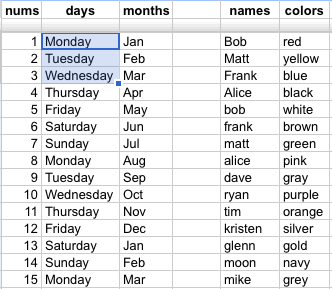
Google Spreadsheets now added some nifty ways to auto-fill data. For instance, rather than typing all of the days or months, you can simply type two or three, select them, and then drag the little blue square in the bottom right corner of the selection. Then, the rest of the days or months will be populated below. That is nice, but what I think is much more interesting, is that you can click and drag holding while down Ctrl (Windows and Linux) or Option (Mac) to pull data from Google Sets. So, in the image below, I only filled in the first three rows of each column. Then, I used the former technique to auto-fill the first three columns and the latter technique (holding down Ctrl or Option) to auto-fill the extra twelve rows.

Nowadays, software developers, such as Google, have a great opportunity to utilize the ginormous pile of data available online. The data that individuals generate is ever increasing and can be extraordinarily useful.


Save R Plot in EPS format

Here is a code example of how to save an R plot in EPS (instead of PS):
postscript(file="testplot.eps",
paper="special",
width=10,
height=10,
horizontal=FALSE)

yvalues = runif(50)
plot(yvalues)

dev.off()
The variation is adding paper="special" and horizontal=FALSE.

Friday, May 16, 2008

Java Programming Notes

Java Programming Notes is a handy Java reference by Fred Swartz. In his words, he explains:
These Java programming notes are written to fill in missing or weak topics in textbooks that I've taught from. Many pages are useful for reference, but not as an ordered tutorial. Some pages are still rough drafts, but I'm slowly working on fixing them.

Monday, May 05, 2008

Walmart Visualization

Here is an interesting animation of Walmart Store growth overtime. Below is a snapshot of the movie in progress (1991).

Sunday, May 04, 2008

Virtual Host Setup

To add a virtual host on your local machine (running apache), do the following two things:

1. Add a virtual host definition to your apache configuration file, like this:

<VirtualHost *:80>
ServerName sitename
DocumentRoot "/location/of/your/site/"
</VirtualHost>

2. Add a corresponding line to your HOSTS file (on my Mac, it is located at /etc/hosts).

127.0.0.1 sitename

You should then be able to access your site in any Web browser by going to:

http://sitename

This then allows you to develop locally in an environment nearer to how it will likely be deployed.

Friday, May 02, 2008

Abstract classes and Interfaces

In response to some of the questions asked in class today, I compiled some properties of interfaces and abstract classes that should help guide your choice when deciding when to use an Abstract class or an Interface as a parent class.

Neither an Interface nor an Abstract class can be instantiated. Both can be used to as a template for concrete (implemented) child classes.

Interfaces
  • example interface definition:
public interface Monkey {
public double getWeight();
public void setWeight(double w);
public void walk();
public void talk();
}
  • fields (i.e., members, variables) are not allowed
  • all methods are implicitly abstract
  • a child class can implement many interfaces in Java
  • child classes must implement all methods
Abstract Classes
  • example abstract class definition:
public abstract class Monkey {
private double weight;
public Monkey(){
}
public double getWeight(){
return weight;
}
public void setWeight(double w){
weight = w;
}
public abstract void walk();
public abstract void talk();
}
  • may have members (e.g., weight)
  • may have implemented methods (e.g., getWeight, setWeight) and abstract methods (e.g., walk, talk)
  • a child class can only extend a single parent class in Java (multiple inheritance is not allowed)
  • child classes must implement all of the parent's abstract methods
Section 4.4 in Data Structures and Problem Solving in Java discusses this more extensively. 

This talks more about when you might use one, the other, or both. Furthermore, I found some questions and answers about the two that interviewers like to use. ;)

Java Tutorials

Sun provides some excellent tutorials that cover most aspects of programming in Java. Learning the Java language is a set of tutorials, or "trails", on the following fundamental topics:
The content of these trails is also available as a book, called The Java Tutorial, Fourth Edition.

Wednesday, April 23, 2008

ForwardTrack

ForwardTrack is an open source tool (now entirely written in php) that allows email campaigns to be tracked and mapped as they are forwarded from person to person. This is definitely useful as it reveals the spread of information and some of the underlying social network.