Tuesday, March 24, 2009

Tweeting Blog Posts


I just automated the process of making a tweet on Twitter whenever I make a new post on this blog. I set this up using a free service called TwitterFeed.  As a side note, it allows you to do this fo multiple blogs.  

If all goes well, then you will see this post (and all future posts) on my Twitter stream: @smithworx

Things that Make People Happier

Martin Seligman spoke at the BYU forum today in the Marriott Center. Listening from my office I found it quite interesting and relevant, particularly with the doom and gloom ever present in the news. Here are a few tips that he mentioned (they had be learned primarily through controlled experiments):
  • Write down three things that went well today and why they went well. (After six months on average you will be happier.)
  • People that deploy their greatest strengths will be happy.
  • "Active Constructive Responding" helps marriages succeed.
  • Do something philanthropic and your whole day go better.
Finally, he directed everyone to his Authentic Happiness website for more information on being happy.

Monday, March 23, 2009

Spring Research Conference at BYU

Here are the slides form the presentation that I gave at the Spring Research Conference at BYU last weekend.


Monday, March 16, 2009

Finding Gold in Waste

I first learned about this here, but wanted to share it again.  In short, before you discard all of your junk, you might want to be sure that it is indeed worthless.  In the video below, these guys are finding gold in the sewage.

Tuesday, February 03, 2009

Tolerance and Acceptance


Dr. Barbara Culatta gave an excellent devotional today on being tolerant and accepting people around you. She effectively discussed the seven tips below:
  1. Look for Commonalities
  2. Accept People Where They Are
  3. Reflect on Goodness in Other Religions
  4. See Differences as Part of Life
  5. Value What We Can Learn From Others
  6. Serve People from Different Faith and Backgrounds
  7. Give a Soft Response When Criticized
Each of these suggestions (with the exception of #1) encourages us to build "bridging" relationships with people different from us. Tip #1 reminds us that in order to effectively build bridging relationships, we need at least some common ground. When it gets right down to it, we have something in common with everyone (e.g., we are all human beings, we all need food and water). Bridging social capital increases as we establish these types of relationships. Bridging capital is usually harder to obtain as it requires more effort to establish, yet, it is often more rewarding since it gives connecting parties access to resources and information that they otherwise would not have.

These useful tips that can help us be more effective at building these bridges, which improve our social networks.

Monday, February 02, 2009

Using Color in Latex

Have you ever wanted to use color in latex? It is actually pretty simple. All you need to do is include the color package:
\usepackage[usenames]{color}
Then you can use simple commands like:
\textcolor{Red}{I like Red.}
To produce:
Here is a list of the 68 standard colors that you could use:
Apricot Aquamarine Bittersweet Black Blue BlueGreen BlueViolet BrickRed Brown BurntOrange CadetBlue CarnationPink Cerulean CornflowerBlue Cyan Dandelion DarkOrchid Emerald ForestGreen Fuchsia Goldenrod Gray Green GreenYellow JungleGreen Lavender LimeGreen Magenta Mahogany Maroon Melon MidnightBlue Mulberry NavyBlue OliveGreen Orange OrangeRed Orchid Peach Periwinkle PineGreen Plum ProcessBlue Purple RawSienna Red RedOrange RedViolet Rhodamine RoyalBlue RoyalPurple RubineRed Salmon SeaGreen Sepia SkyBlue SpringGreen Tan TealBlue Thistle Turquoise Violet VioletRed White WildStrawberry Yellow YellowGreen YellowOrange
Furthermore, you can define custom colors by specifying the RGB values as follows:
\definecolor{MyCrazyColor}{cmyk}{0.2,0.8,0,0.1}

and then using it as you would the other colors, like so:
\textcolor{MyCrazyColor}{My text in my crazy color.}

Read more about it at Bent Peterson's site.

Friday, January 30, 2009

Social Capital in Startup Networks

Social capital in action surrounds us. Below is a list of sites focused on the niche of starting up new businesses. In order for such ventures to be successful, it is often necessary to build a team of individuals that have complementary attributes and abilities. We are currently working on ways that we can quantify some of these behaviors given the rich data that is generated online everyday.

Wednesday, January 28, 2009

Social dimensions of social media

Below is the slide presentation that Marc Smith gave at ICWSM. I met Marc at the CIKM 2008 Workshop on Search in Social Media (SSM 2008) in Napa Valley, CA. He is a creative thinker that is always interesting to watch and listen to.

Also, you can watch the video of this presentation by clicking the picture below:

Social dimension of social media (Marc Smith)

Enjoy!

Thursday, January 15, 2009

Family Reunion on Facebook

Reunion sites are used primarily to "get the word out" about the reunion (e.g., location, events, cost), gather people's information (e.g., family member names), collect dues, and share family media (e.g., stories, pictures, videos).

Traditionally, I've been the guy that gets asked to build the reunion website --- as I'm involved in the planning meetings. Through the years, I've built a few high school reunion sites and a family reunion site. Through the process I have reused much of the code, yet they have all been "custom" websites. Although I had big plans to make my code generic enough that anyone could create a reunion site, I never took the time to do it. Since creating my last reunion site there have been a number of others that have taken the time to do this. For example, Ning and MyEvent are among a host of such sites that people have used to create reunion sites.
Currently, I believe that the quickest and most efficient way to do a reunion website is on Facebook. Here are a few reasons why I currently believe it to be most efficient solution:
  • It is free
  • No coding is necessary (saving time and money)
  • Lots of your family is likely already using Facebook, so they will not have to register for another account or re-enter information
  • People using Facebook already have media shared and can easily share more, which makes it easy to "catch-up" with family members
  • It is easy to create a Group specifically for you family reunion allowing family members to join
  • It is easy to create a "Related Event" for the group (i.e., the reunion activities) that members can easily indicate whether or not they plan to attend
  • In general, it is much more interactive than any of the other reunion sites
  • It may even be "one of the most fulfilling experiences of [your] life"
  • The Network will continue on, even after your planned event is over
So, to all that may wish to utilize my services to build them a reunion website... I'm still at your service, so long as we do it on Facebook. ;)

Saturday, December 27, 2008

Recording Skype Calls

Here are the basic settings that I used on a Mac to record Skype conversations using SoundFlower, Skype, and Audacity.

SoundFlower

Default Input: SoundFlower (2ch)
Default Output: Built-in Output

Skype
Audio output: SoundFlower (2ch)
Audio input: SoundFlower (2ch) (if you wan't to record both sides of the Skype call)
Built-in Microphone (if you only wish to record the other side of the conversation)

Audacity

Recording Device: SoundFlower (2ch)
Playback Device: Core Audio: Built-in Output

You could record many other things using similar configurations. Happy Recording!

Update: Since writing this I happened to come across another tutorial on doing this with pictures, that you might wish to follow.

Tuesday, December 16, 2008

Network Roles

Social networks tend to have people that fill positions within the community. For example, within an academic community the roles of being a professor or a student can sometimes be identified solely by using the directed interactions among the individuals. To perform such an analysis, some measure of equivalence is used. In Social Network Analysis by Wasserman and Fauts, the following definitions of equivalence are reviewed (each with a note):
  1. Structural Equivalence - requires identical ties to other identical actors
  2. Automorphic and Isomorphic Equivalence - requires identical ties to other actors
  3. Regular Equivalence - actors have identical ties to and from equivalent actors
  4. Local Role Equivalence - actors are role equivalent if they have the same role sets
  5. Ego Algebra Equivalence - based on algebra of relational structuresSo, why is knowing how to use this important? Well, say you would like to better understand the network surrounding your blog by learning which other blogs are similar in their ties as you, then this is how you could do it.

Friday, November 28, 2008

Blog Posts Increasing and Cyclic


During the span of a year, the over 200 blogs aggregated above show very cyclic behavior. It shows very prominently that these bloggers post significantly more posts during the week rather than on the weekends.

Additionally, as time went on, these blogs as a group posted more frequently.

I would guess that the sink during December was caused by the Christmas holiday.

Tuesday, November 25, 2008

Christmas Gift Giving Tool

Christmas is a time for gift-giving --- sometimes, families and friends need a quick way to determine who gives to who. So, I created this little tool that allows families and friends to quickly enter the names of people (that will be giving and receiving gifts) to have gift-giving list automatically (and randomly) generated.


It is nice to have a tool like this so the lists can be generated early and gift-giving becomes that much easier --- you don't have to wait until somebody gets the old hat out and writes down everyone's name. Additionally, it seems to be more fair and is less complicated. ;)

The program was built using Python and Google App Engine.

Thursday, November 20, 2008

LaTex: Vertical Text

Scientific publications in computer science are often created using LaTeX. Here is a little tip for making text appear vertically in Latex.
First, you need to include the following library:
\usepackage{rotating}

Next, you can use the sideways environment, as follows:
\begin{sideways}YOURTEXT\end{sideways}

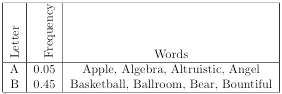
Finally here is an example used within a table:
\begin{tabular}{|r|r|c|}\hline
\begin{sideways}Letter\end{sideways} & \begin{sideways}Frequency\end{sideways} & Words \\
\hline
A & 0.05 & Apple, Algebra, Altruistic, Angel \\
B & 0.45 & Basketball, Ballroom, Bear, Bountiful \\
\hline
\end{tabular}

Which produces:

Tuesday, November 04, 2008

Obama: 44th US President

Barack Obama has been elected as the next President of the United States of America. I enjoyed following the election coverage this season as it was particularly exciting. Although my first choice for President was Mitt Romney, I believe that Obama will work to unite the country and improve International relations.